
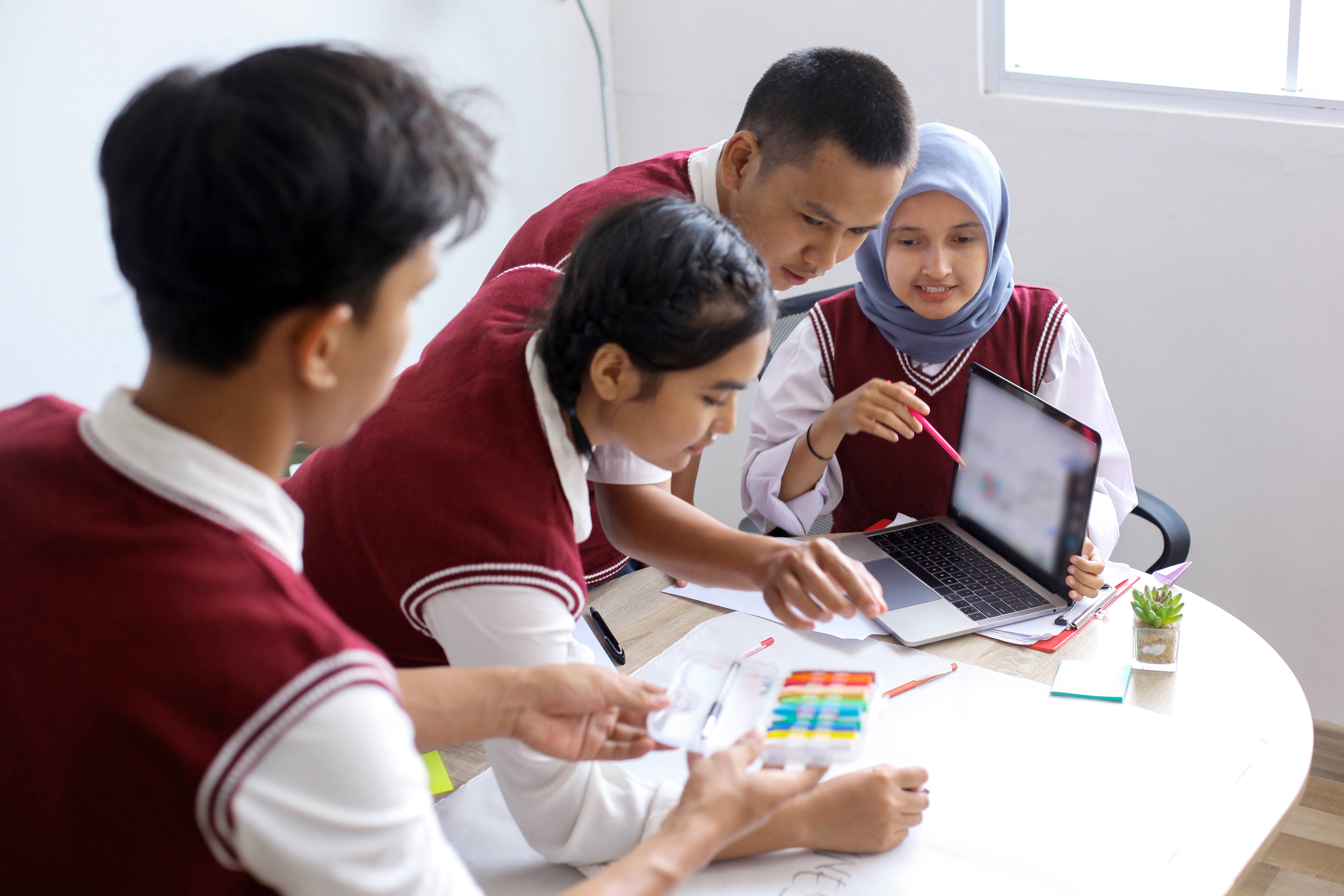
Education today is no longer limited to memorising facts or listening passively in classrooms. Today, with the rapid changes taking place in education, student engagement is a priority, in addition to educational outcomes. One-way instruction is being replaced with more active forms of teaching, and collaborative learning is an excellent example.
Table of Contents
- What Does Collaborative Learning Mean?
- Importance of Student Engagement
- How Collaborative Learning Improves Student Engagement
- Benefits of Collaborative Learning
- Examples of Collaborative Learning
- Collaborative Learning in the Classroom
- Role of the Teacher in Collaborative Learning
- Strategies for Collaborative Teaching and Learning
- Preparing Students for the Future
- Students’ Choice of School Environment
- Why Collaborative Learning is Important at Mayoor School
- Conclusion
- FAQs
Student engagement has become a key indicator of effective education, influencing not only academic performance but also confidence, curiosity, and long-term learning habits. One approach that has gained strong recognition for improving engagement is collaborative learning. By encouraging students to interact, share ideas, and work together toward common goals, collaborative learning creates a more dynamic and inclusive classroom environment. It helps learners feel valued, heard, and motivated, transforming classrooms into spaces where learning becomes an active, shared experience rather than a one-sided process.
What Does Collaborative Learning Mean?
Collaborative learning is a type of learning where students are organised into small groups and work together to accomplish the same learning objectives. They do not work in isolation; rather, they discuss ideas and supplement each other’s understandings.
When considering what is collaborative learning, it is important to go beyond just being in a group. There is a higher level of structure, responsibility, and participation, which makes the students equal partners as creators of knowledge rather than as passive receivers.
Importance of Student Engagement
When students are engaged, they are more focused and exhibit a positive willingness to be active in classroom exercises. With increased engagement, students comprehend and retain information with more substantial and positive academic performance. With collaborative approaches, engagement is an integral element of design, as they create social and interactive learning experiences that are relevant to the world.
How Collaborative Learning Improves Student Engagement
The student engagement and learning experience in a classroom can be enhanced via collaborative learning in the following ways:
-
Active participation: Students speak, listen, and contribute to the learning experience.
-
Shared ownership: Students are responsible for their success and their peers’.
-
Increased motivation: Students are more motivated when learning in groups.
-
Real-world relevance: Working in groups to learn to reflect on real-world experiences, like problem-solving.
Clearly, collaborative learning in the classroom enhances motivation and engagement.
Benefits of Collaborative Learning
The collaborative learning experience can prove beneficial to the students on a personal level, rather than just the learning outcome.
-
Improved communication skills. Learning to articulate their thoughts. In addition to active listening and respecting differing viewpoints.
-
Stronger critical thinking. While working in groups, one can analyse the ideas, question, and gain a deeper understanding of the topic.
-
Boosted confidence. Students who are shy and lack the confidence to speak in front of the whole class can break the communication barrier and feel more comfortable in the presence of smaller groups.
-
Enhanced social skills. Working in collaborative groups teaches them empathy and individual and collective problem-solving.
-
Higher retention of knowledge. Learning how to explain ideas and concepts to their peers improves the retention of information.
The benefits of collaborative learning create a nurturing and supportive environment to enrich student development holistically.
Examples of Collaborative Learning
Even if the methods may vary somewhat, many collaborative learning examples can be adopted by educational institutions:
-
Presentations and projects done in groups
-
Activities where peers teach and review each other
-
Discussions that involve thinking, pairing, and sharing
-
Group analyses of case studies
-
Activities that involve the solving of problems collaboratively
These methods offer students the opportunity to become active participants in the learning process, thus enhancing the quality of learning.
Collaborative Learning in the Classroom
The most effective collaborative learning in the classroom needs to be planned. It can be useful to divide students into different-sized groups, establish clear goals, and assign specific activities to be completed by each group to promote focus and accountability. When collaboration is structured properly, it ensures that all students participate and that all students gain from the experience, no matter what their learning preference is or what their abilities are.
Collaboration in classroom activities is often perceived by students to be more exciting, and classrooms that promote collaboration tend to be more energetic.
Role of the Teacher in Collaborative Learning
The role of the teacher in collaborative learning is to design group activities and tasks for groups that promote collaboration. Teachers are expected to:
-
Facilitate, rather than dominate, discussions
-
Manage discussions so that participants do not unfairly dominate
-
Offer students the opportunity to provide and receive peer feedback
-
Encourage reflection
This keeps the focus of collaboration on the intended learning and keeps the collaboration aligned with the concise learning goals.
Strategies for Collaborative Teaching and Learning
Successful classrooms implement a range of collaborative teaching and learning strategies, which include:
-
Mixed-ability grouping for peer learning
-
Real-world applications through project-based learning
-
Collaboration through technology and digital tools
-
Reflection after group processes
These strategies increase and sustain learner engagement.
Preparing Students for the Future
In addition to the academic benefits, collaborative learning teaches students important skills for future careers that require teamwork, communication, and problem-solving. Students who engage in collaboration early on develop a strong ability to adapt and the skills to lead, which benefit them in and out of the classroom.
Students’ Choice of School Environment
Progressive and future-ready education requires parents to choose schools that foster collaboration, communication, and student participation. Children learn best in an environment where ideas can be shared and discussions can be held. This approach boosts student confidence and social awareness along with academic learning. Such environments foster independent thought, curiosity, and respect for different viewpoints.
When assessing the best school in Noida, parents, more often than not, consider collaborative learning as a significant contributing factor, as it produces well-rounded children, emotionally and academically. Children with both school and life skills become adaptable to the challenges of the real world. A school that fosters teamwork and collaborative learning instils leadership and other essential skills needed to excel in all areas of life.
Why Collaborative Learning is Important at Mayoor School
Collaborative learning is a crucial component of the teaching philosophy and everyday classroom practice at Mayoor School. Our school understands that students learn best when they are involved and learn from each other. Active learning occurs in classrooms, in groups, and in structured discussions. Students are motivated to ask questions and share and defend their opinions.
Combining collaborative learning with a strong academic foundation, Mayoor School develops critical thinking, teamwork, and problem-solving skills. We foster understanding of the subjects and prepare students to be flexible, effective communicators, and successful in a fast-changing world.
Conclusion
Collaborative learning has emerged as a powerful tool for enhancing student engagement and overall classroom effectiveness. Promoting teamwork, communication, and shared responsibility, it shifts the focus from passive instruction to active participation. Students not only understand concepts more deeply but also develop essential life skills such as problem-solving, empathy, and adaptability. When guided by thoughtful teaching strategies, collaborative learning supports diverse learning styles and encourages every student to contribute meaningfully. As education continues to prepare students for an interconnected world, collaboration becomes more than a classroom strategy—it becomes a life skill. Schools that adopt collaborative learning approaches cultivate confident, curious, and capable learners who are better equipped to succeed academically and excel beyond the classroom.
FAQs
1. How is collaborative learning different from traditional classroom teaching?
Ans. Collaborative learning shifts the focus from passive listening to active participation. Instead of one-way instruction, students work together, discuss ideas, and solve problems, which improves understanding, communication skills, and long-term knowledge retention.
2. Can collaborative learning benefit introvert students?
Ans. Yes. Structured group activities give introvert students a safe space to express ideas gradually. Small-group discussions help them build confidence, practice communication, and participate meaningfully without the pressure of speaking in large classroom settings.
3. What age groups benefit most from collaborative learning?
Ans. Collaborative learning benefits students across all age groups, be it from early years to senior classes. Younger students develop social skills, while older learners strengthen critical thinking, leadership, and teamwork abilities essential for higher education and careers.
4. How do teachers manage classroom discipline during collaborative activities?
Ans. Teachers play a guiding role by setting clear objectives, assigning roles, and monitoring group interactions. Well-planned collaborative tasks promote focus and accountability, reducing disruption while encouraging responsible and respectful participation.
5. Does collaborative learning improve academic performance?
Ans. Yes. Research shows that students engaged in collaborative learning often perform better academically. Sharing perspectives, explaining concepts to peers, and problem-solving together deepen understanding and enhance overall learning outcomes.
